Custom xarray indexes for keeping multiple coordinates in sync across shared dimensions.
Overview
This library provides custom xarray Index implementations that automatically constrain related dimensions when you select on any one of them.
DimensionInterval
The DimensionInterval provides the ability to performantly store arbitrary intervals over a continuous coordinate. Like a multiindex but more generalized. See the comparison with MultiIndex for an understanding of the comparison.
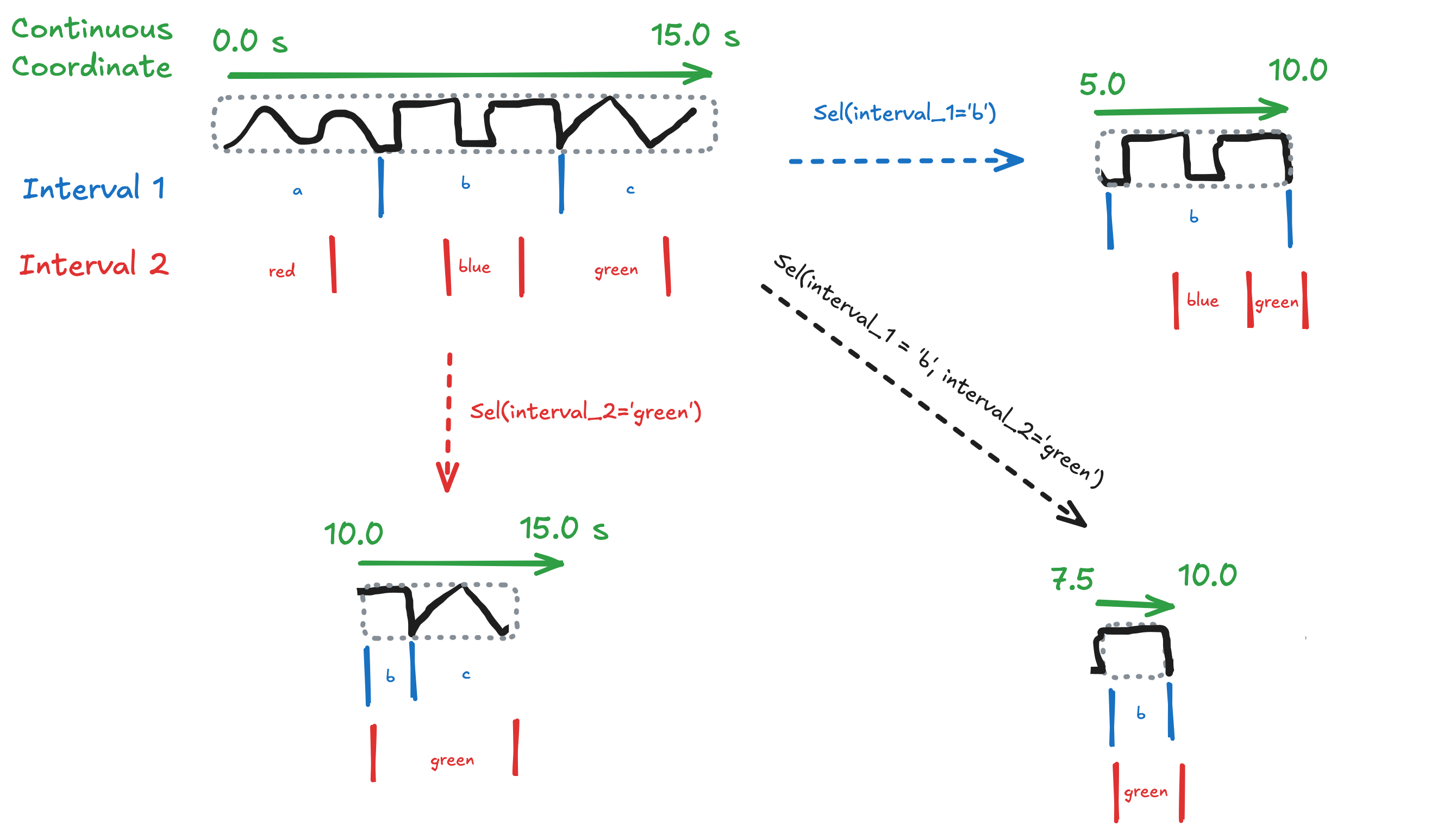
See the Multi-Interval Example for a detailed walkthrough.
NDIndex
Provides the ability to select on N-dimensional derived coordinates (like absolute time computed from trial offsets + relative time).
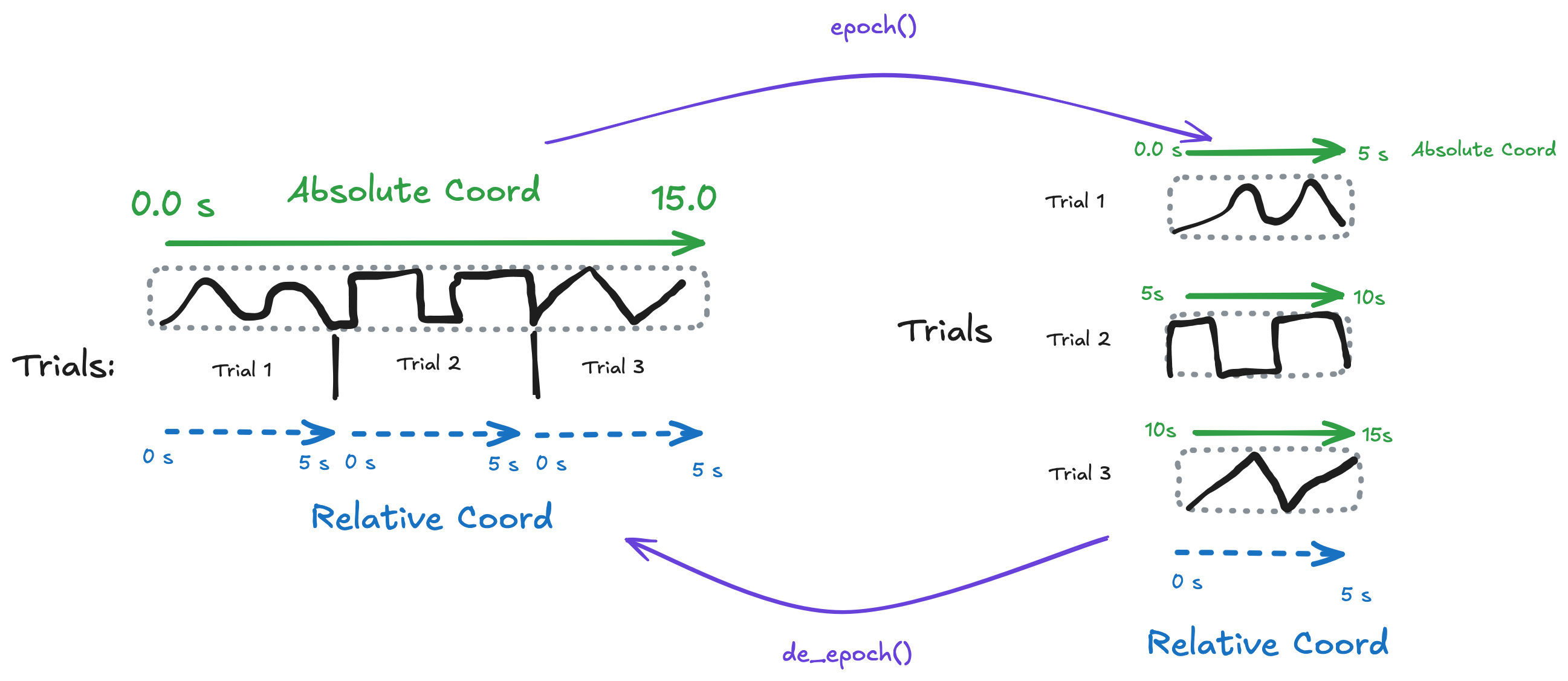
See the ND Coordinates Example for a detailed walkthrough covering trial-based data with both absolute and relative time coordinates.
Use Cases
Speech/audio data with hierarchical annotations (words, phonemes, time)
Time series with multiple granularities of events
Any data where intervals at different scales need to stay synchronized
Installation
pip install git+https://github.com/ianhi/xarray-linked-indexesQuick Start
from linked_indices.example_data import multi_interval_dataset
from linked_indices import DimensionInterval

# Load example dataset with time, words, and phonemes
ds = multi_interval_dataset()

# Apply the linked index
ds = ds.drop_indexes(["time", "word", "phoneme"]).set_xindex(
    ["time", "word_intervals", "phoneme_intervals", "word", "part_of_speech", "phoneme"],
    DimensionInterval,
)
ds
Now selecting on any dimension automatically constrains all other dimensions to overlapping values:
# Select word "red" - time and phonemes are auto-constrained to [0, 40)
ds.sel(word="red")
Using onset/duration format
As an alternative to creating pd.IntervalIndex objects, you can use onset/duration coordinates directly. This is useful when your data comes from annotation tools that export onset + duration format.
ds = ds.drop_indexes(["time", "word"]).set_xindex(
    ["time", "word_onset", "word_duration", "word"],
    DimensionInterval,
    onset_duration_coords={"word": ("word_onset", "word_duration")},
)
Options:
onset_duration_coords: Dict mapping dimension names to(onset_coord, duration_coord)tuplesinterval_closed: How intervals are closed ("left","right","both","neither"). Default:"left"
See the Onset/Duration Example notebook for a detailed walkthrough.
Examples
See the example notebook for a detailed walkthrough of multiple interval types (words, phonemes) over a shared continuous time dimension.
API Reference
DimensionInterval
The main index class for linking multiple interval dimensions over a single continuous dimension.
Features:
Automatic cross-slicing between all linked dimensions
Support for multiple label coordinates per interval dimension
Works with both
sel()andisel()operations
Known Limitations:
Array indexers (fancy indexing) not fully supported for interval dimensions
Non-contiguous intervals (gaps) are supported but may produce unexpected results when computing time ranges that span multiple intervals